NOTE: Skills management is available only to administrators and global content editors (users with no hierarchy level assigned).
The Skills dashboard
You can access the Skills dashboard from the menu on the left.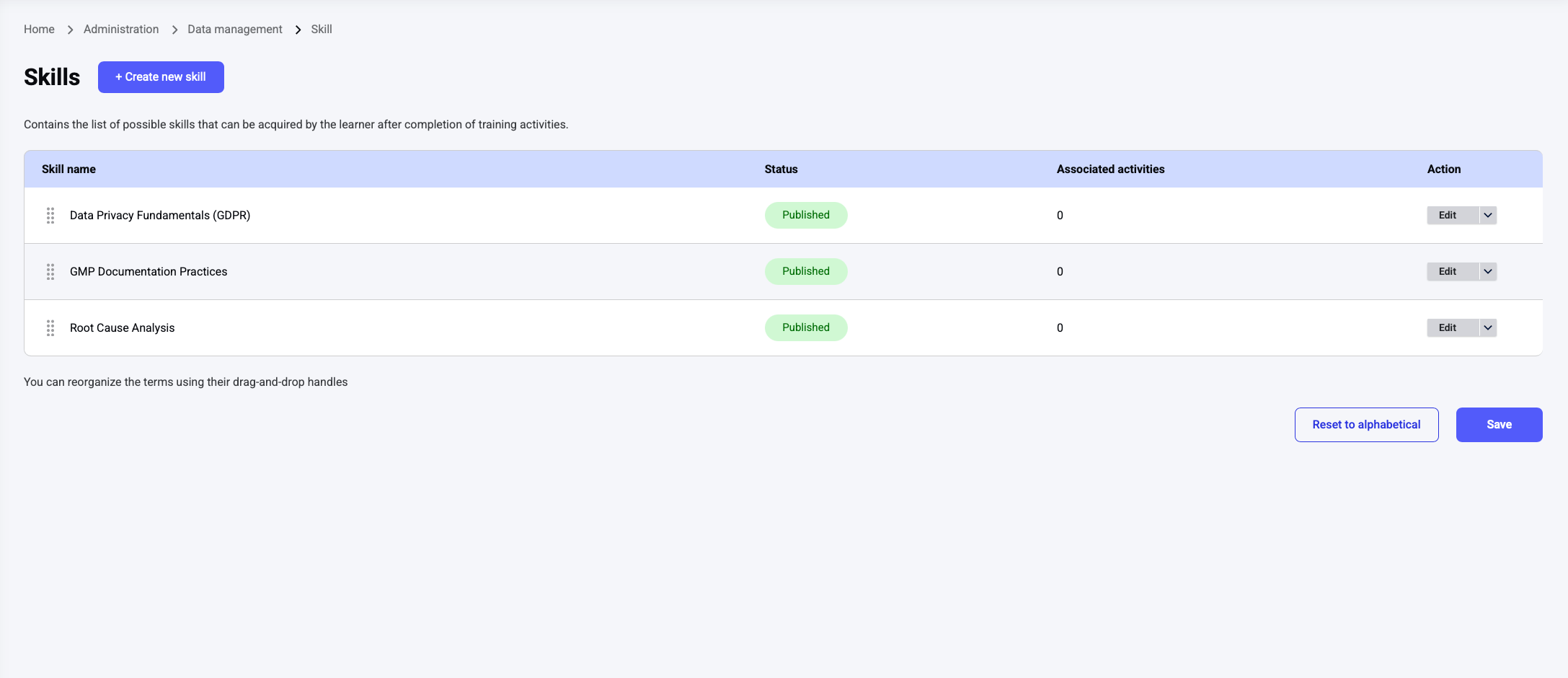
- Skill name
- Status: Active or Disabled.
- Associated activities: The number of activities the skill is assigned to. Click the number to open a popup listing those activities.
- Actions: Edit, Disable, or Enable (see below).
Creating a skill
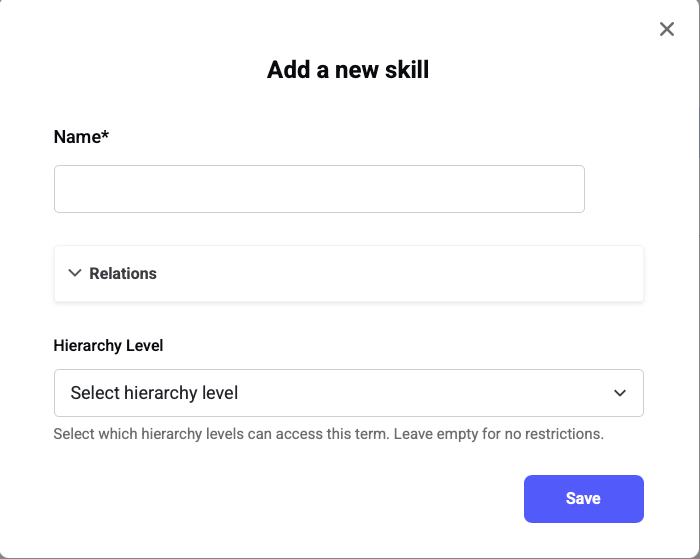
Click the Create new skill button at the top of the dashboard and define the skill’s name. Optionally, you can also:- Select parent skills to organize skills into a multi-level hierarchy.
- Assign a hierarchy level to the skill. When a skill has a hierarchy level:
- Content managers can select skills at the same or lower levels.
- Only learners at the same or higher levels can see the skill.
Editing a skill
Click the Edit action next to a skill to update its name.Enabling and disabling skills
Use the Disable and Enable actions to control whether a skill is active.- A skill can be disabled only if it is not assigned to any activity.
- Disabled skills remain visible in the acquired skills of learners who have already earned them.
- Re-enabling a previously disabled skill does not reassociate it with the activities it was linked to before.
Assigning skills to activities
You assign skills to activities when creating or editing an activity, not from the Skills dashboard.- In the activity interface, toggle on Assign skills.
- Select up to 3 skills using the autocomplete field, or click Assign skills with AI to let Opigno AI detect the applicable skills.
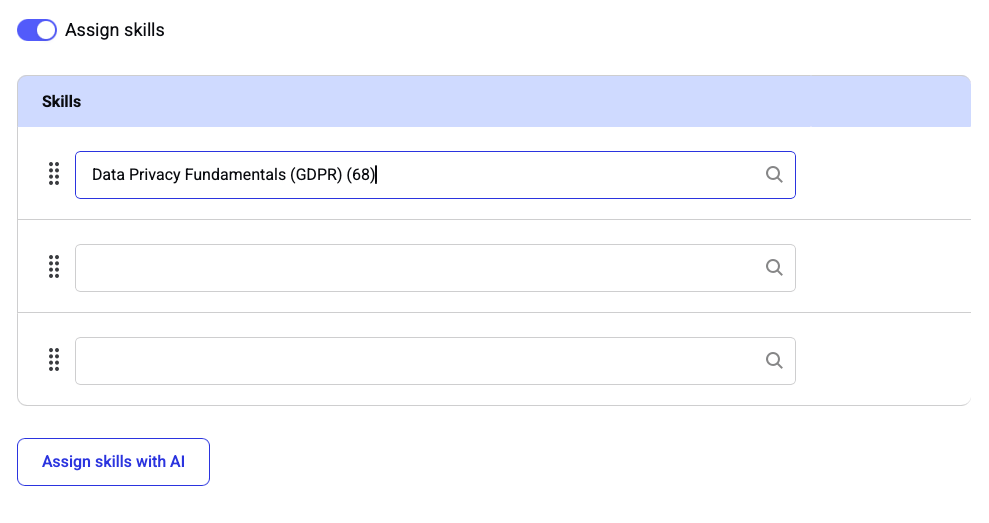
NOTE: New skills cannot be created from the activity interface — only existing skills can be assigned.
How a skill is acquired
A learner acquires a skill once they answer 3 consecutive activities associated with that skill correctly — meaning a score above 90% on each. The following rules apply:- If a learner repeats an activity, it is counted only once toward a skill.
- If new skills are added to an activity a learner has already completed and they repeat it, only the newly added skills are considered.
- Once acquired, a skill is never lost — for example, if the learner restarts the training, takes another training containing the same activity, or later answers that activity incorrectly.
NOTE: Skills cannot be acquired from activities that belong to a theory module.
Target skills and the skills spider chart
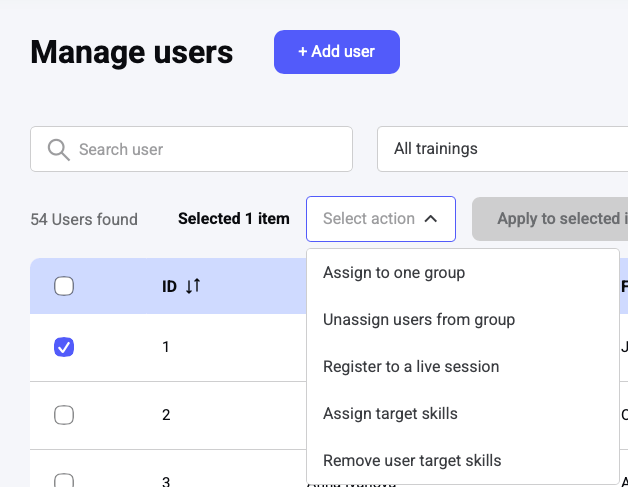
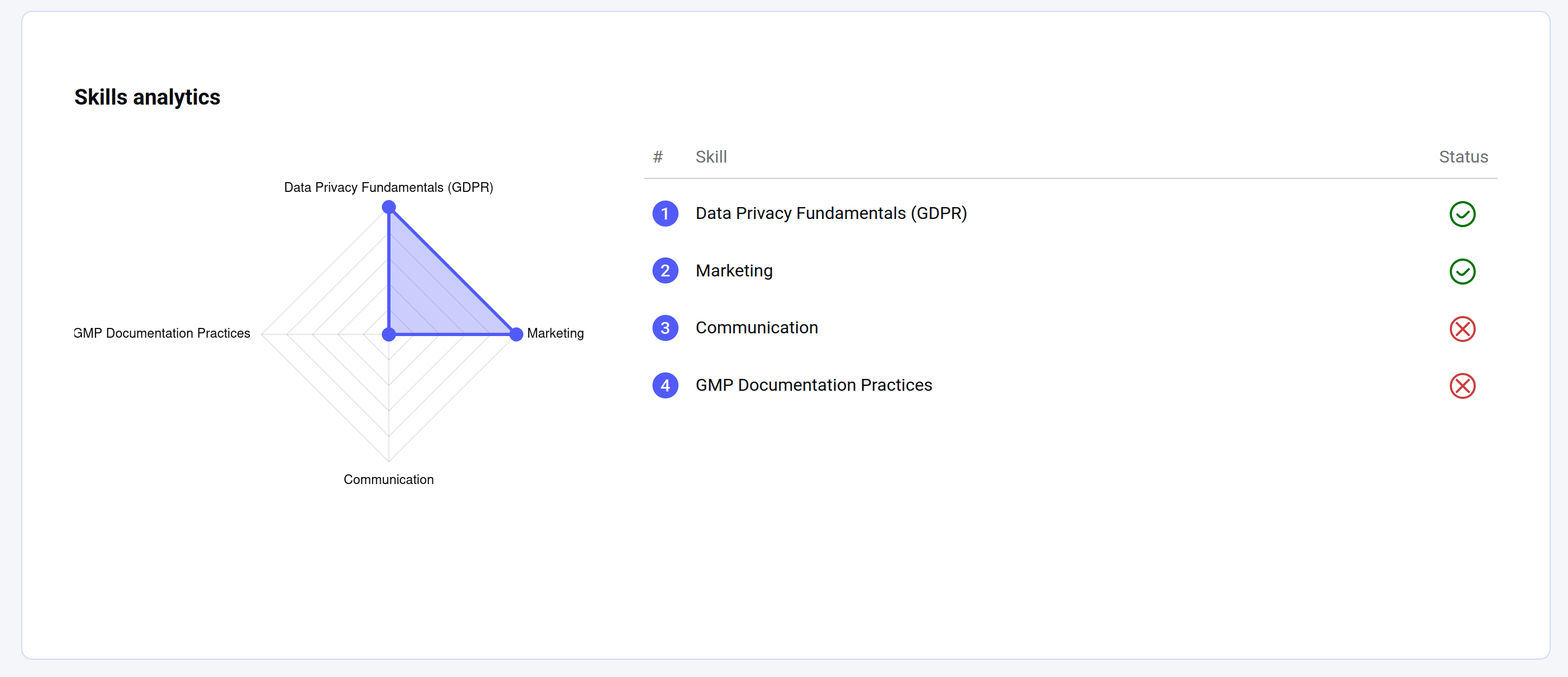
For each learner, managers (or Clara) can define the target skills expected of that person — for example, based on their job description. To assign target skills, open the Manage users interface on the learner platform, select one or several learners, and use the Assign target skills action.